
Where to Eat
What's open in Estes Park in winter?
How Estes Park changes after fall: shorter hours, Trail Ridge Road closed, what the Park offers on snow, and how to drive US 34 and US 36 in winter.
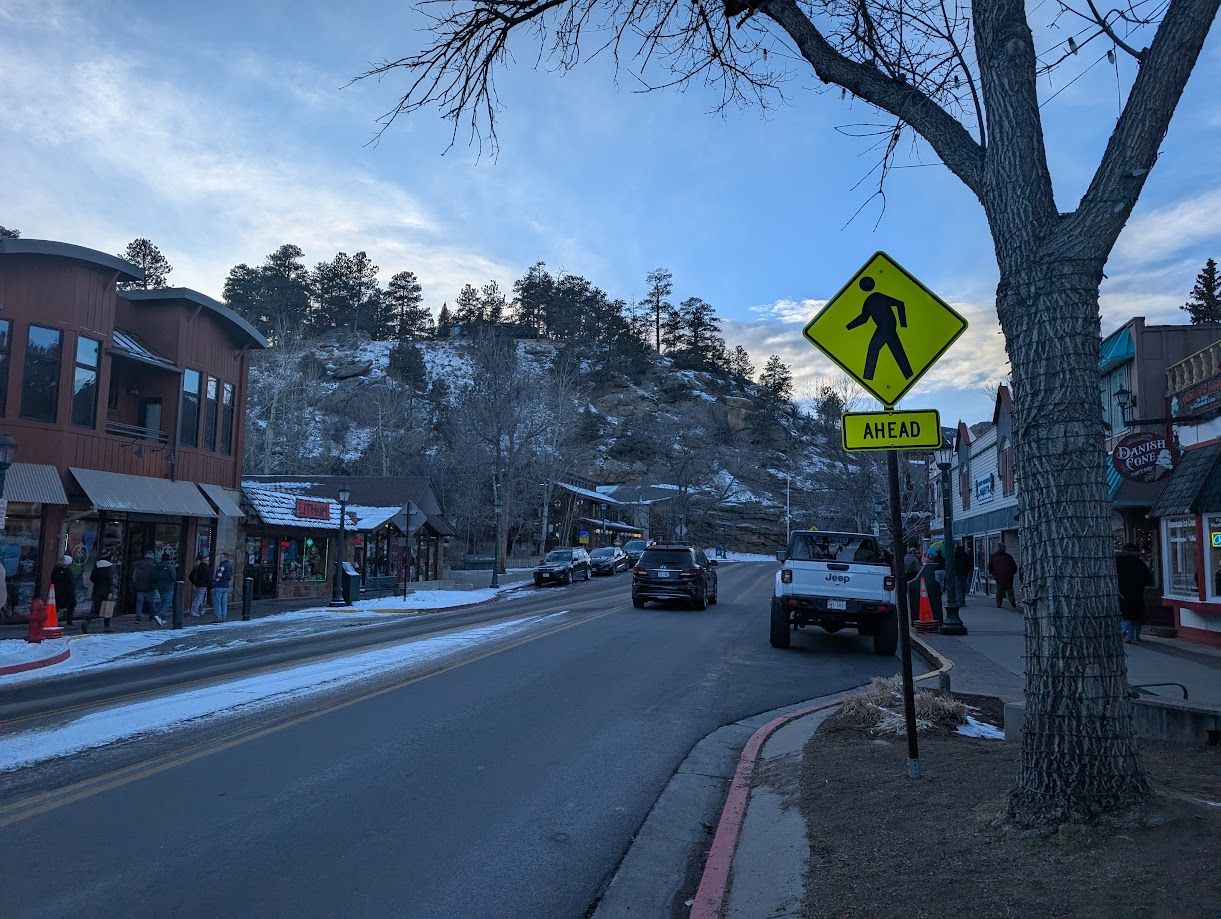
I live up the hill in Allenspark, and I’ve spent a lot of years in towns that fold up when the tourists leave. Estes Park isn’t one of them. The tourism board says it plainly: Estes Park is a town, not a park, and a town has to keep functioning in February. People live here, and they eat, buy things and need somewhere to put their relatives.
That said, October through April is a different place than July. Here’s how I’d plan around it.
How the town changes after fall
The elk rut winds down around mid-October, and the crowds go with it. What’s left is a town running on local traffic and a steady trickle of winter visitors.
Expect three things. Hours get shorter, with some places closing a day or two a week that they wouldn’t in summer. A number of seasonal businesses shut for part of the winter, usually the ones built around summer foot traffic. And the ones that stay open tend to be the ones that serve year-round residents: restaurants and bars, local retail, lodging, and the guides and gear shops that cater to snow sports.
Which kinds of places run reduced schedules is the part I can generalize about. Which specific ones, and when, is not something I’ll put in print, because it changes with the snow and the owner’s mood. That’s what the listings on this site are for. Each one shows its open season, so use the Restaurants, Hotels and Gifts sections as your first filter and then pick up the phone.
Calling ahead is not fussy here. A two-minute call beats driving up a canyon to a dark window.
Trail Ridge Road closes
Trail Ridge Road is not an all-season road. The Park Service points out that eleven miles of it sit above 11,500 feet, with few guardrails and no shoulders. The Park’s own directions page says it’s closed from roughly mid-October through late May, and the actual date depends on the weather. Some years it closes earlier than you’d like.
When it closes, the east side shuts down at Rainbow Curve, and the west side at the Colorado River Trailhead. That means you cannot drive over to Grand Lake. Bear Lake Road stays open year-round, with snow and ice expected, and the Park warns that the Colorado traction law can be activated at any time. Check the 24-hour Trail Ridge Road line at 970-586-1222, or call the information office at 970-586-1206.
The part people miss: once the gates are closed and winter trail status begins, the closed roads are open to snowshoers, skiers and walkers. Bikes and pets are generally not allowed past the gates in that period. Dates for the switch vary by year, so read the current notice on nps.gov/romo.
Old Fall River Road
Old Fall River Road is the gravel alternative to Trail Ridge, and it’s a summer road. It closes to vehicles in early October, earlier than Trail Ridge. After that it reopens to bicycles, pedestrians and leashed pets for the winter season, with a brief closure for maintenance work in some years. If you want to see it with a car, you missed the window. If you want to walk it in the quiet, check the Park’s current notice first.
What the Park offers in winter
The Park does not close, and winter is when a lot of locals like it best.
Snowshoeing. The Park says most trails can be explored on snowshoes with not much more than the shoes and insulated boots. Be realistic about it: the east side trails are mostly not marked for winter use, so carry a map and a compass or other navigation, and don’t assume you can follow last week’s tracks. Avalanche terrain is real on slopes between 30 and 45 degrees. If you’re headed anywhere near that, check the forecast and carry a beacon, probe and shovel, and know how to use them.
Hidden Valley sledding. Hidden Valley, just below Many Parks Curve off Trail Ridge Road, is the only designated sledding area in the Park. Sleds and tubes are the usual choice, and skis or snowboards without bindings are allowed. Stay inside the roped-off area and keep off the old ski runs. Heated restrooms are available, and the warming hut is open weekends only. Bring your own sled, or buy or rent one from a shop in town. The season runs as snow permits, so early and late in winter it can simply not be there.
Bear Lake area. Bear Lake is a good snowshoe destination, but sledding is not allowed there. People still show up with tubes and get turned around, so save yourself the trip.
Weather changes fast and winds can gust. The Park also warns against parking or camping where trees could fall, especially after a storm.
Driving US 34 and US 36 in snow
Most people come up one of two ways: US 34 through the Big Thompson Canyon from Loveland, or US 36 from Lyons and Boulder. Both are canyon roads, and both can be fine at noon and ugly at dusk. I’d treat any storm day as a day to reconsider.
What I’d actually do:
- Check COtrip.org or call 511 before you leave, not when you’re halfway up. CDOT’s own guidance is to look before you travel.
- Know the traction law. From September 1 through May 31 it is in effect on the I-70 Mountain Corridor, and CDOT can activate it on other state highways when conditions call for it. It requires tires with at least 3/16 inch of tread that are winter-rated (mountain snowflake), all-weather, or mud and snow, or chains or an approved traction device on two or more drive tires. Violations carry a fine. Look at the CDOT page for the current requirements, because they were updated recently.
- Stay back from plows. CDOT suggests three to four car lengths, and passing a plow running its lights in tandem is a Class A offense.
- Clear the snow off your roof, not just the windshield.
If you’re coming from the west side, the Park’s directions page notes that US 40 can close or have restrictions due to snow.
Elk in town
The big bulls are done with the show by now. In winter, the Park says, elk herds drop to lower elevations, and the winter herds are mostly cows, calves and young bulls. That is how you end up with elk on lawns and golf courses in town.
Stay at least 75 feet away, which is about two bus lengths. Don’t feed them, don’t crowd them, and give them room on a sidewalk. A cow with a calf is not impressed by your camera.
Winter events, and one I can confirm
The one I can point to is the Catch the Glow Parade on Elkhorn Avenue, which the tourism office lists as a free event, held the Friday after Thanksgiving in recent years. Estes Park’s holiday season has a lot of other events built around it, but dates move and details change, so check the visitor center’s events calendar for this year’s schedule instead of taking mine. I’m not going to list anything I can’t confirm.
The short version
Call ahead. Check the listing’s open season. Check CDOT. Pack a shovel, a blanket and more water than you think you need, and plan to be off the canyon before dark.
Winter’s the season I like Estes Park best, and I’ll still tell you to call first.
Official sources
- https://www.nps.gov/romo/learn/news/trail-ridge-road-is-closed-to-through-travel-for-the-2024-season.htm
- https://www.nps.gov/romo/planyourvisit/road_status.htm
- https://www.nps.gov/romo/planyourvisit/directions.htm
- https://www.nps.gov/romo/planyourvisit/upload/East-Side-Winter-Trails.pdf
- https://www.nps.gov/romo/learn/nature/elk.htm
- https://www.denvergazette.com/2026/09/29/historic-road-that-hits-11796-feet-to-close-for-winter/
- https://www.visitestespark.com/rocky-mountain-national-park/winter-and-spring/sledding/
- https://www.visitestespark.com/blog/post/does-estes-park-close-in-the-winter/
- https://www.visitestespark.com/events-calendar/holidays/holiday-parade/
- https://www.codot.gov/news/2025/november/new-traction-law-requirements
- https://www.codot.gov/travel/winter-driving